There are no items in your cart
Add More
Add More
| Item Details | Price | ||
|---|---|---|---|

AI coding agents can now write, test and modify software at a scale that would have seemed unrealistic a few years ago. But there is one thing they still cannot remove from software development: human judgment.
September 24, 2026
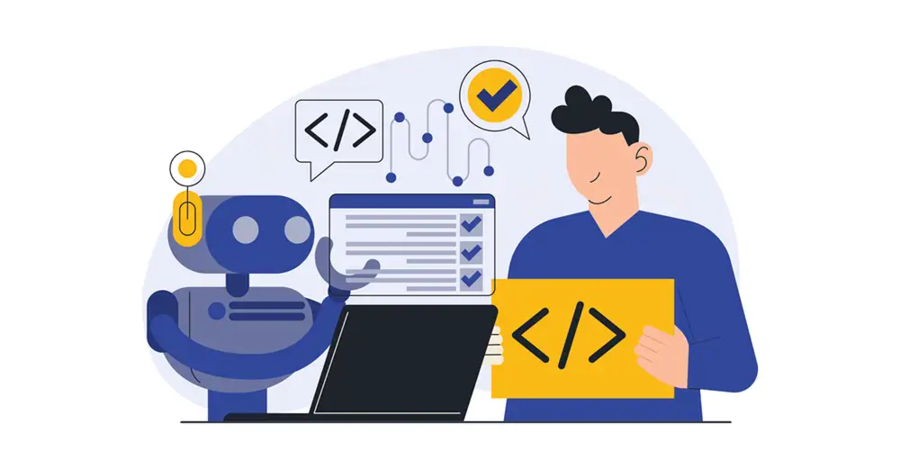
For decades, software development was closely associated with writing code. Developers designed a solution, opened an editor and translated their ideas into programming languages.
That relationship is changing quickly.
Modern AI coding tools can generate functions, write tests, refactor code, investigate bugs and work across entire repositories. Coding agents can also take on longer tasks, use development tools and iterate on their work with much less direct intervention from a developer.
OpenAI has described this shift as moving from humans writing code toward humans steering agents that execute software tasks. Anthropic's 2026 research similarly describes software development as increasingly moving toward orchestrating agents while retaining human judgment and oversight. :contentReference[oaicite:0]{index=0}
This creates an interesting paradox: AI can produce more code than ever, yet human expertise is becoming important in different ways.
The question is no longer simply whether AI can write code. The bigger question is whether the code solves the right problem, works reliably and fits the system around it.
Consider a simple software project.
A developer might previously spend several days implementing a feature. They would write the code, search documentation, debug errors, create tests and eventually prepare the feature for deployment.
An AI coding agent can now perform a significant portion of those implementation steps.
This changes the economics of software development. When generating code becomes easier, writing more code is no longer necessarily the difficult part.
The bottleneck can move somewhere else.
These are not merely code-generation problems. They are engineering and decision-making problems.
One of the biggest changes in AI coding is the move from suggestions to execution.
Earlier coding assistants were mainly autocomplete systems. They predicted what code might come next.
Modern coding agents can operate at a much higher level.
A developer can give an agent a task such as:
"Add user authentication, update the database schema, create the API endpoints, add tests and fix any failures."
The agent may inspect the repository, determine which files need modification, make changes, run tests and iterate based on the results.
OpenAI's 2026 research on agentic work describes this transition as a shift from short interactions toward delegated, long-horizon tasks. Its research on internal coding workflows also reports that coding agents are being used for increasingly substantial research and engineering work. :contentReference[oaicite:1]{index=1}
The important point is that AI is increasingly doing the execution.
Humans still have to define the destination.
There is an interesting pattern emerging in how people work with coding agents.
In a 2026 analysis of roughly 400,000 Claude Code sessions, Anthropic reported that people generally made most of the planning decisions while Claude made most of the execution decisions. The research also found that greater domain expertise was associated with more work being completed per instruction. :contentReference[oaicite:2]{index=2}
This suggests something important.
AI does not necessarily make expertise irrelevant. In many workflows, expertise can make AI more useful.
A developer who understands databases can give an agent better database requirements. A security engineer can identify dangerous assumptions. A product engineer can explain what the feature actually needs to accomplish.
The AI may produce the implementation, but human knowledge helps determine what good implementation looks like.
There is another side to AI-generated software.
When producing code becomes extremely cheap, teams can end up producing more code than they can effectively understand, review and maintain.
Imagine a developer manually writing 5,000 lines of application code. They have probably spent considerable time thinking about its structure.
Now imagine an AI system generating 50,000 lines across several tasks.
The second system may have been built faster, but the amount of code that needs to be reviewed, tested and maintained has also increased.
This creates a new engineering problem: code generation is becoming abundant, while attention remains limited.
Human attention is still needed to inspect important decisions, understand failures and identify problems that automated tests may not catch.
One of the easiest mistakes when evaluating AI-generated code is to ask only one question:
"Does it work?"
That question matters, but it is not enough.
Good software also needs to be understandable, maintainable, secure and appropriate for the system it belongs to.
Consider an AI-generated authentication system. It might successfully allow users to log in during testing. But a security engineer would also want to ask:
AI can help implement these systems, but the responsibility for understanding the consequences of design choices does not disappear.
Software rarely exists in isolation.
A piece of code might interact with a company's business processes, customers, legal requirements, security policies and legacy systems.
An AI model can analyse the information it receives, but the quality of its decisions depends heavily on the context available to it.
Suppose a company asks an AI agent to redesign an internal dashboard.
The agent may be able to create an attractive interface quickly. But it may not know that the finance team depends on a particular report format, that some users have restricted access or that a certain workflow exists because of an operational requirement.
Someone has to understand those constraints.
That is where human domain knowledge becomes extremely valuable.
Working effectively with AI is not about delegating everything.
It is about deciding what should be delegated and what should remain under closer human control.
A developer might comfortably delegate repetitive tasks such as generating boilerplate, writing basic tests or updating documentation.
A developer may want much stronger review for security-sensitive authentication logic, financial calculations, database migrations or changes that could affect production infrastructure.
This is becoming an important part of AI-native engineering: risk-based delegation.
Low-risk tasks can move faster. High-risk tasks require stronger testing, review and approval.
OpenAI's documentation on running coding agents safely describes this approach through access boundaries, approval requirements and telemetry that helps teams understand what agents are doing. :contentReference[oaicite:3]{index=3}
Human review used to mean a developer looking at a pull request before merging it.
With increasingly autonomous agents, oversight itself is becoming more structured.
Teams can use automated tests, code review systems, sandboxes, permission controls, monitoring and approval workflows to keep agents within defined boundaries.
Anthropic's research on trustworthy agents highlights the importance of controlling what agents can access and do, rather than relying only on users to manually approve every action. :contentReference[oaicite:4]{index=4}
This creates a fascinating shift.
Instead of asking humans to manually supervise every line generated by AI, engineering teams can build systems that automatically verify routine work and direct human attention toward higher-risk decisions.
In other words, the future of human oversight may itself be partly automated.
This is one of the most difficult questions raised by AI coding.
If AI can handle many of the repetitive tasks traditionally given to junior developers, how will beginners gain experience?
There is no simple answer yet.
On one hand, AI can allow beginners to build projects much faster and learn by experimenting with real software.
On the other hand, relying on generated code without understanding it can create shallow technical knowledge.
The solution is not to avoid AI. Instead, learners need to use AI as a tool while deliberately developing the ability to explain, debug and evaluate the generated work.
A beginner who can ask an AI agent to build an application is learning something useful. A developer who can also explain why the application works, identify its weaknesses and improve its architecture is building a much stronger skill set.
The rise of coding agents does not make programming fundamentals obsolete.
In fact, the ability to review AI-generated code may make fundamentals more important.
Developers should understand concepts such as:
You do not need to memorise every syntax detail when AI can generate code for you.
But you do need enough understanding to recognise when the generated solution makes sense and when it does not.
As AI takes over more implementation work, the developer's role can move upward in the abstraction stack.
Instead of spending most of the day writing individual functions, developers can spend more time designing systems, defining interfaces, establishing constraints and building feedback loops.
OpenAI's description of its agent-first engineering workflow captures this shift with a simple idea: humans steer while agents execute. The engineering challenge becomes designing an environment where agents can produce reliable work and receive useful feedback. :contentReference[oaicite:5]{index=5}
That does not mean every developer will suddenly become a software architect.
It means that as implementation becomes easier, higher-level engineering decisions can occupy a larger share of a developer's time.
There is a common assumption that if AI writes more code, humans will simply have less work to do.
The reality can be more complicated.
When implementation becomes faster, teams can attempt larger projects, run more experiments and create more software. That can increase the amount of work involved in deciding what to build, testing what was built and maintaining the resulting systems.
Anthropic's 2026 agentic coding research describes this as a shift from writing code toward orchestrating agents, while emphasising that active human judgment and validation remain important. :contentReference[oaicite:6]{index=6}
So the future may not be "AI does the work and humans relax."
It may be "AI does more execution, while humans spend more time on decisions that determine whether the execution is useful."
If you are learning programming today, there is no reason to choose between traditional programming and AI tools.
The more useful approach is to learn both.
The most valuable developer may not be the person who can write the most code manually.
It may be the person who can turn a messy real-world problem into clear requirements, guide AI effectively and recognise when the resulting software is good enough to trust.
Modern AI coding systems can generate code from natural-language instructions and increasingly operate across multiple files, tools and development tasks. This makes it possible to delegate more implementation work to AI agents.
AI can reduce the amount of manual implementation work, but developers still need to define requirements, make architectural decisions, review results, test systems and manage risks. The role is changing rather than simply disappearing.
AI can reason about requirements provided in its context, but real products often involve business constraints, user expectations, organisational knowledge and domain-specific decisions. Humans remain important for providing and validating that context.
Yes. Programming knowledge helps developers understand, debug and evaluate AI-generated code. It also makes it easier to communicate technical requirements and make sound architectural decisions.
One major change is the shift from developers manually implementing every task toward developers delegating larger tasks to AI agents and supervising the results. This moves more human effort toward planning, review, architecture and decision-making.
AI is already changing the amount of software that can be produced. Coding agents can generate code, modify repositories, run tests and handle tasks that previously required substantial developer effort.
But more generated code does not automatically mean better software.
Someone still needs to understand the problem, define the requirements, choose the right architecture, evaluate the result and take responsibility for the system.
That is why human expertise still matters.
The future developer may write fewer lines of code personally, but their decisions can influence far more code than before. The advantage will come not from competing with AI at producing code, but from knowing what to build, what to delegate and what to question.
Anas Khan
Technology and data science writer.